RefreshAgent Real-world case study

Observed Google Search Console data · through 27 October 2026

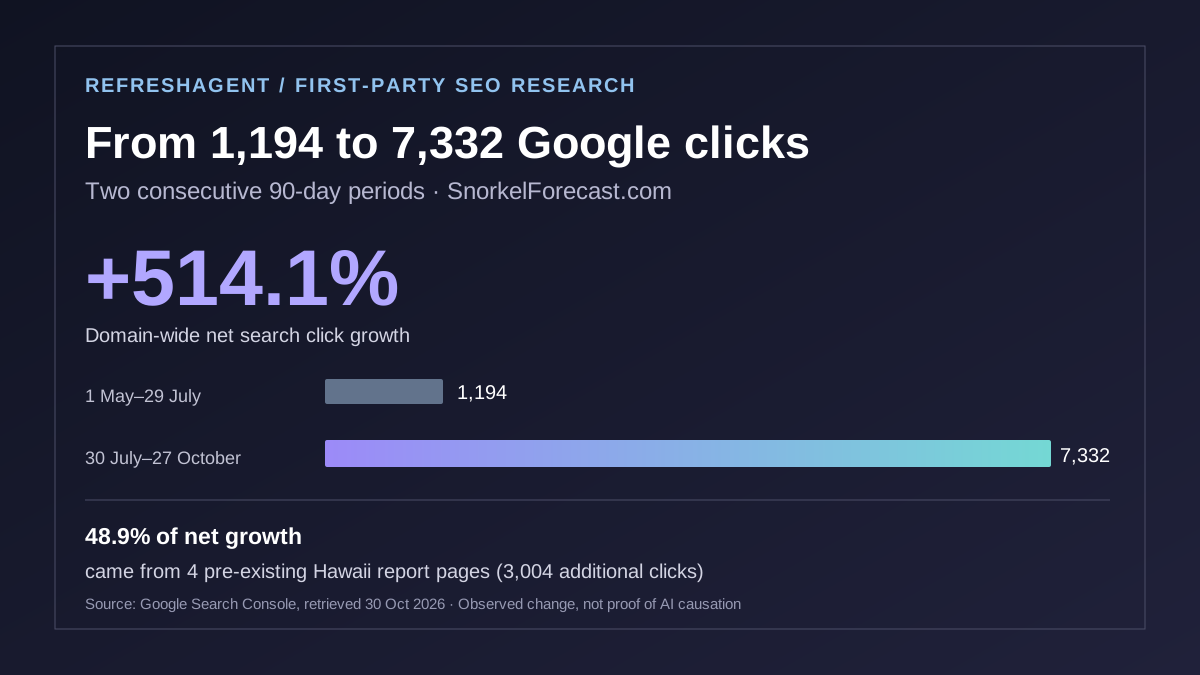
From 1,194 to 7,332 Google clicks: inside an AI-assisted SEO growth workflow.

A 90-day study of search visibility, page-level contributions and documented changes to SnorkelForecast. This is evidence of website growth—not proof that AI agents caused it.

SEARCH CONSOLE / 90-DAY COMPARISONOBSERVED, NOT ATTRIBUTED
+514.1%Google organic search clicks
Previous 90 days1,194
Latest 90 days7,332

30 July–27 October versus 1 May–29 July 2026. This measures total website search growth, not traffic caused by a particular agent or deployment.

Google Search clicks7,332+514.1% from 1,194
Search impressions291,145+539.4% from 45,531
Aggregate CTR2.52%Down from 2.62%
Average position7.79From 10.87 (lower is better)

What the search data actually shows

Two equal, consecutive 90-day Search Console periods, measured for the whole domain. These bars show period totals, not a fabricated daily trend.

SOURCE · FIRST-PARTY GOOGLE SEARCH CONSOLE
Google Search clicks+514.1%
1 May–29 July1,194
30 July–27 October7,332

6,138 net additional clicks across the domain.

Google Search impressions+539.4%
1 May–29 July45,531
30 July–27 October291,145

245,614 more search-result impressions.

A surprising result

Search clicks grew 6.14×, yet aggregate click-through rate fell slightly, from 2.62% to 2.52%. The overall click increase is associated with substantially more impressions, not a higher aggregate CTR. Changing query mix and positions also matter.

What is measured

Google Search Console for sc-domain:snorkelforecast.com. Previous: 1 May–29 July 2026. Current: 30 July–27 October 2026. Retrieved on 30 October through the owner's authorised RefreshAgent connection. The results are a fixed snapshot; Google can revise historical records.

What is not proven

This is observational website-wide evidence. AI contribution, seasonality, indexing, new content and parallel changes have not been causally isolated. Google Search clicks are not GA4 sessions, bookings or revenue. A change in average position does not mean every query improved.

Four existing Hawaii reports explain nearly half the net click increase

The Maui, Oahu, Kauai and Big Island pages all received Google clicks in the earlier comparison window. Their net gains total 3,004 clicks, equal to 48.9% of the site's 6,138 net additional clicks.

DERIVED · EXACT PAGE-LEVEL GSC JOIN
Net additional Google Search clicks · consecutive 90-day windows

Reproducible calculation

(1,889 + 467 + 326 + 322) ÷ 6,138 = 48.94%. The denominator is the net domain-wide click change, not the sum of only winning pages. These four selected pages are a subset, not the complete decomposition of all existing versus newly published URLs.

Maui rose from 522 to 2,411 clicks; Oahu from 41 to 508; Kauai from 2 to 328; Big Island from 18 to 340. Earlier-period clicks establish that these pages existed and had search visibility before 30 July; they do not establish which individual changes caused the gains.

What changed—and what can actually be substantiated

The dated internal growth log and experiment register document concrete changes. A planning entry, code implementation and verified production deployment are different levels of evidence; none alone establishes a traffic effect.

DOCUMENTED WORK · CAUSAL EFFECT NOT ISOLATED
  1. Documented change

    Maui report intent and answer-first coast summaries

    The growth log records a Maui-focused title and description, clearer coast comparisons, forecast-based best/weakest beach explanations and official observation links. The original goal was to improve report-query rankings toward position 5. The log does not independently prove the precise production deployment timestamp or its traffic effect.

    Evidence: current Maui report · internal SEO growth log, 3 August.

  2. Implemented in code

    One coast-level report per Hawaiian island

    The project log describes expanding the Maui report approach to Oahu, Kauai and Big Island, including coast-level forecasts and relevant internal links. The log calls for a post-deployment review; the exact live date and page-level traffic effect have not been verified for this study.

    Evidence: four current island reports · internal SEO growth log, 12 September.

  3. Review pending

    Lead with a useful future daytime forecast

    The experiment register records a Hawaii-specific change intended to avoid leading evening visitors with a nighttime 'Poor' verdict. A completed 14/28-day performance review and independent production verification are not established here. No uplift is attributed to this experiment.

    Evidence: internal experiment EXP-2026-09-22-hawaii-daytime-lead · outcome pending.

Original expectation

At the August baseline, the recorded goal was better Maui report-query positioning and clearer information for visitors—not a prediction of sixfold sitewide growth. The query-specific position-5 objective has not been verified as met.

Alternative explanations

New pages, expanding query coverage, seasonality, parallel releases and changes in Google's indexing are plausible contributors. This dated timeline is an evidence map, not an experiment isolating the causal contribution of RefreshAgent or other tools.

Research files and reproducibility

The published evidence is a dated snapshot, not a silently changing dashboard. The page export covers the twelve largest positive gainers returned, while the domain totals cover all URLs.

Reproduce the calculation

Use Google Search Console for the same property and two non-overlapping 90-day windows. Normalise the canonical page URLs, subtract prior-period clicks from current-period clicks for each of the four Hawaii reports, add those differences and divide by the domain-wide net click increase. The top-gainers CSV alone does not reproduce the whole site's total.

Research still open

Not computed: the complete share of growth from all existing versus all newly published pages. That requires the complete GSC URL inventory and validated publication/deployment history. A seasonally adjusted counterfactual, attribution to an individual AI agent, conversion uplift and revenue uplift have not been established.

Check the shorter window too

The latest 30-day comparison (28 September–27 October) recorded 3,197 clicks versus 2,799 in the previous 30 days (29 August–27 September): +14.2%. This provides a more recent, less dramatic measure alongside the longer-term 90-day result, not a directly comparable claim.

Data provenance: owner-authorised GSC property retrieved through RefreshAgent on 30 October 2026; data through 27 October. The page-level CSV is a selected set of positive gainers, not the full search-performance inventory. No customer account or private authentication data is included. Snapshot corrections should produce a new version rather than silently rewriting historical evidence.

For journalists and researchers

Three concise, independently quotable observations with exact dates and limitations.

01 / OBSERVED7,332 vs 1,194 Google clicks

+514.1% across consecutive 90-day periods for the whole website.

02 / DERIVED48.9% of net click growth

Four pre-existing Hawaii report URLs accounted for 3,004 of the 6,138 net additional clicks.

03 / LIMITATIONNot causal attribution

No controlled study isolates the effects of RefreshAgent, coding agents, indexing or seasonality.

This first-party study covers a website operated by RefreshAgent's founder, Duncan Trevithick. It is not an independent customer case study. The site develops original calculated marine-condition information rather than publishing generic AI travel articles. Please cite the specific source snapshot and methodology; researchers seeking additional context can contact the author through his public profile.

The agent-assisted growth loop

Use the AI you already have. Give it reliable data, a bounded task and a way to verify changes.

  1. 01

    Observe actual search demand

    RefreshAgent connects to Google Search Console and GA4. The agent sees the same page, query and period evidence we use to make human decisions—not guessed search volumes or generic AI SEO advice.

    REFRESHAGENT / GSC
  2. 02

    Choose one useful improvement

    Compare opportunity size, intent and the site's ability to add original information. Favor computed snorkeling facts and better answers over producing more near-duplicate travel articles.

    EVIDENCE + JUDGMENT
  3. 03

    Work in the real application

    A scheduled Hermes SEO workflow and coding agents inspect the Django repository, propose bounded changes, run checks and record work in Git. RefreshAgent provides SEO evidence and analysis; the coding agents and owner implement and review changes. A Git commit is not proof of production deployment.

    HERMES / GIT / DJANGO
  4. 04

    Measure again before declaring victory

    Experiments include a baseline, guardrails and 14-/28-day reviews. Search Console needs time after publication; an opportunity detected today shouldn't be marketed as an uplift tomorrow.

    GSC / EXPERIMENT LOG
Feedback loopResults feed the next decision—not an automatic content factory

Earlier examples from the work queue

These are dated opportunity snapshots from 9 October, not evidence that the follow-up experiments succeeded. Newer sitewide and page-level results appear above.

01 / MAUI REPORTPOST-DEPLOYMENT REVIEW

Make the forecast answer obvious

Query: “maui snorkel report”

5,402impressions4.68%CTR

RefreshAgent flagged a high-impression search term with room to improve its click-through rate. Work on the Maui forecast report focuses on clearer search snippets and an unmistakable current-conditions verdict using stored marine data.

Outcome: latest changes under review; no uplift claimed yet.

Inspect the live Maui report ↗
02 / DESTINATION GUIDEPOST-DEPLOYMENT REVIEW

Thousands of impressions, no clicks

Query: “best places to snorkel”

4,533impressions0clicks

The best places to snorkel page was visible in results but not attracting this query's clicks. Instead of making another listicle, the work focuses on useful destination decisions, backed by real conditions and derived data where coverage allows.

Outcome: search-intent and consolidation changes are recent; measure after indexing.

Inspect the destination guide ↗

Example query/page observations: Search Console 30-day data ending 9 October 2026. Metrics identify opportunities; they do not establish that the experiments succeeded.

More useful facts.
Fewer generic pages.

SnorkelForecast is a data product. It combines marine forecasts, water temperatures and historical conditions to answer questions like where or when to snorkel. AI can help decide which answers need improving, but it doesn't get to invent ocean conditions or safety guarantees.

Compute, don't pad

Produce comparisons and derived facts from defensible sources, not paraphrased destination blurbs.

Separate observation from inference

A Search Console CTR gap is observed. An explanation for the gap is a hypothesis until tested.

Keep changes reviewable

Bounded commits, correctness tests and logged experiments matter more than an agent publishing endlessly.

Try the workflow on your own site

Start with a real decision, not a vague request to “do SEO.”

STARTER PROMPTWORKS WITH YOUR OWN AI
Analyze my site's Google Search Console performance for the last 30 days versus the previous 30. Find three opportunities supported by exact page and query evidence. Prioritize changes that create genuinely useful information. Recommend one bounded improvement, the metric to watch and a 28-day review plan. Never invent data or claim a result before measuring it.

What RefreshAgent does: securely supplies your Search Console/GA4 evidence and deterministic SEO analysis. Your existing ChatGPT, Claude Code, Codex or other supported MCP client does the reasoning with its own model access. The hosted RefreshAgent agent is optional.

What it doesn't do: guarantee rankings, automate every site change by itself or establish causality from observational traffic charts.

MAKE YOUR AI MORE USEFUL

Connect the data.
Keep the judgment.

Give your AI real search performance, discover one useful improvement, then measure the result. That's the part worth automating.

Connect your AI to SEO data →Explore SnorkelForecast ↗No new AI subscription required to use the MCP tools with your own model client.